

Spintax has been here for a while and was created to fix 1 problem.
How do you make one copy of text unique and produce multiple content variations?
The answer was spintax.
Spintax is a simple text format used to create many variations from one article, sentence or word,
The word itself takes inspiration from spinning (ie to rewrite content) and syntax.
Spinning + Syntax = Spintax
TLDR, its just a way to keep variations of a word or sentence and store them together like a thesaurus. When it comes time to write the spintax to normal text, we take a random copy from that list.
What does spintax mean?
Spintax = “spinning syntax.” Its just a format to encode variations in text.
Eg Simple spintax looks like this:
{editing|reviewing} your {content|articles} is {important|essential}
Just that one line can create variations like:
- Editing your content is important.
- Reviewing your content is important.
- Editing your articles is essential.
- Reviewing your articles is essential.
The curly brackets show the part that can change. The pipe symbol separates each possible option.
What is spintax syntax?
Spintax syntax is the structure used to tell a spinner which choices it can use.
The common format is:
{option 1|option 2|option 3}
Each part has a job:
| Spintax part | What it does | Example |
|---|---|---|
| Curly brackets | Wrap the words or phrases that can change | {fast|quick} |
| Pipe symbol | Separates each option | fast|quick |
| Options | The words, phrases, or sentences the spinner can choose from | {fast|quick|rapid} |
You can spin one word. You can also spin a whole phrase, sentence, paragraph, or link.
There are other less common examples using [|].
However the meaning is the same.
Did you know, there use to be a few competing versions of spintax, {} or [] etc. This made spintax converters a thing!
What is the correct spintax format?
The correct spintax format uses curly brackets around choices and pipe symbols between choices.
Basic format:
{word one|word two|word three}
Sentence format:
{Editing your content is important|Reviewing your articles is essential}
Phrase format:
Writing {clear content|useful articles|helpful guides} takes time.
Nested format:
{Editing|Reviewing} your {content|{blog posts|articles}} is {important|essential}
Nested spintax means, putting one spintax inside another spintax group. It can create more combinations and can be nested as many times as you want.
Super spintax? The deeper you went, the more complex it would get and you tried to get to what we use to call “super spintax” or a super spun article. The idea was one giant super spun file that you could re-use infinitely and created unique enough variations for your submission tools.
How does spintax work?
Think of it like a thesaurus.
The first word is the primary word in the dictionary. The other words are acceptable replacements for it. Its basically a thesaurus.
The program resolving the spin would randomly choose a word from the spintax group.
Take this line:
{Editing|Reviewing} your {content|articles} is {important|essential}
A spinner reads each bracket group. Then it picks one option from each group.
That means the spinner can output:
- Editing your content is important.
- Editing your content is essential.
- Editing your articles is important.
- Editing your articles is essential.
- Reviewing your content is important.
- Reviewing your content is essential.
- Reviewing your articles is important.
- Reviewing your articles is essential.
The more choices you add, the more possible versions you create.
But more combinations do not always mean better content. Bad synonyms create weird sentences. Broken grammar is still broken grammar, even if the text is technically unique.
Remove original? Because the first word was most always the “original” word, some programs had the option to skip or drop the first word in a rewrite, just leaving you the rewritten copies behind. You did this to remove any footprint of the original article.
What is spintax used for?
It was used to solve 1 problem, how do I submit the same article to different sites without it getting marked as duplicate content.
You didn't want to write 100 unique articles, that took to much time. Instead you wanted to quickly rewrite sentences or words, then use those permutations to create unique enough looking articles from 1 source article.
The need for spintax was acute when people started using mass submission software like SENuke or GSA SER. Those programs would auto create accounts and auto submit content and try to get backlinks from places like article directories, blog networks, social posts, forum profile or posts.
TLDR Create many versions of one article, insert anchor links, and submit those versions to different sites.
However as Search engines started to fight back, they got better at detecting low-quality duplicated ideas, with unnatural wording. They wanted to find and remove obviously low quality scaled content that existed only to game rankings, ie content farms.
Spintax is just a means to an end, its not a shortcut to making high-quality SEO pages.
Can spintax help with SEO?
Spintax itself is just a cool shortcut for formatting different variations of text together. It does have some use cases.
Typical use cases:
- Testing alternate snippets.
- Creating template variations for internal workflow drafts.
- Building draft variants before a human edits the final page.
Blackhat use cases:
- Publishing hundreds of spun pages with no new value.
- Mass creation of doorway pages.
- Feeding super spun articles into mass submitter programs for back links.
- Trying to avoid duplicate content penalties with surface-level word changes.
How unique is spintax content?
Spintax content can be mathematically unique, especially if you nest the spintax.
The problem in the early days was replacements was done using simple word swaps.
So over spun articles would end up low quality. Ie, stilted language, loats meaning, un-natural phrasing.
As time went on, the sophistication level increased with sentence and eventually paragraph level rewriters. These made content more readable.
If you ran a plagiarism checker on spun text, it may come up entirely unique as long as you changed every 3 word in a sentence.
The old benchmark for a spun enough article was to get something around the 70% unique range. The higher the better.
Back then it was all about unique checks and passing plagiarism checkers.
Now its all about AI content passing AI detectors, ie GPT Zero etc.
Although the technology changed the arms race hasn't.
What is a spintax tester?
Simple. A spintax tester is a tool that previews the output of your spintax and checks whether the format works.
A tester helps you catch problems before you publish or export the text.
Spintax is brittle, a missing } brace and the whole thing would break.
You might have even found some sites that published content that ended with what looked like corrupted content near the end. This was a universal sign that the spintax was corrupted and it dumped the remaining text.
In this way spintax test works like a JSON validator. All it does is make sure correct looking text comes out the other side.
Can you spin hyperlinks with spintax?
Yes, you can spin hyperlinks with spintax, but you need to be careful with the link format.
For example, you can vary anchor text:
<a href="https://example.com">{SEO tool|content tool|automation tool}</a>
You can also vary full links:
{<a href="https://example.com/page-a">page A</a>|<a href="https://example.com/page-b">page B</a>}
The risk is simple. One missing quote, bracket, or closing tag can break the whole link.
How do you spin content in SEO Content Machine?
You can spin, preview, convert, save, and test spintax inside SEO Content Machine.
SEO Content Machine supports paid English spinners, non-English spinners, and the free built-in ‘English rewriter'.
It even supports a whole host of other paid services.
You can see the history of spintax in just the service list.
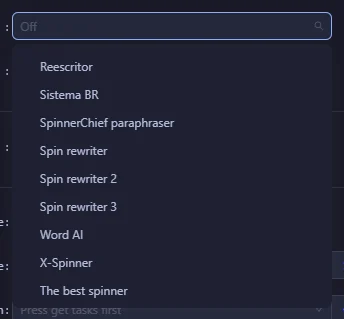
If you need to use a spinner, you can apply it on text via a dropdown.
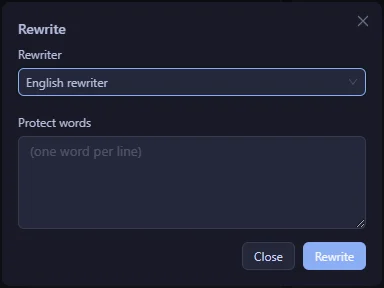
Spinning hello world.
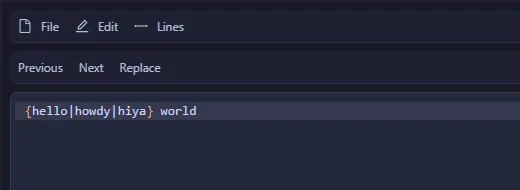
SCM also lets you quickly preview spintax to see possible outputs.

How do you use a custom thesaurus with spintax?
You can use a custom thesaurus when you want more control over the words the spinner uses.
This helps when:
- You want to spin content in another language.
- You have your own approved replacement words.
- You want to avoid bad generic synonyms.
- You need niche-specific terminology.
The thesaurus file should use this format:
original word|replacement 1|replacement 2
Then load the thesaurus file in ‘API Logins' > ‘Rewriter' > ‘Custom rewriter' > ‘Path'.
In SEO Content Machine, pick ‘Custom rewriter' in the ‘Rewriter' dropdown. It uses your custom thesaurus file once you set the file location on your hard drive.
This gives you more control than a generic thesaurus, but you still need to review the final output.
What are the main spintax mistakes?
The main spintax mistakes are broken syntax, bad synonyms, over-nesting, and publishing spun output without review.
| Mistake | What happens | Fix |
|---|---|---|
| Missing bracket | The spinner outputs broken text | Run a tester before export |
| Bad synonym | The sentence sounds wrong | Use higher quality rewriters |
| Too much nesting | Some tools will crash | Keep nesting shallow, 1 or 2 levels deep |
| Spun HTML tags | HTML breaks | Spin plaintext first or find a rewriter that supports HTML |
Should you still use spintax today?
You can still use spintax today, but only as part of a controlled workflow tool, not as the main SEO content strategy.
Largely everyone has moved on from spintax in trying to solve the uniqueness problem. Instead every does use a LLM to generate another copy of the article.
It does have some small usefulness as a utility format.
It can't be used to make content farms anymore, eg See Google penalties on article directories.
For modern SEO, the stronger workflow is different. Start from real search data. Find the missing page or weak page. Draft around the query. Add specific answers. Then publish something a human would actually trust.
That is the shift from old spinning workflows to a modern SEO workspace.
If you use SEO Content Machine today, use spintax where variation helps. For the bigger job, use SEO Workspace: GSC data, topic gaps, draft planning, page refreshes, and content workflows built around real search demand.
Spintax FAQ
What are the spintax text formatting rules?
Wrap the choices in { } and split them with |. Every { needs a closing }.
Is there a spintax tester or spintax checker?
Yes. In SCM, paste your spintax into ‘Article Preview' and click ‘Refresh' to see one random output.
What is a spintax generator?
A spintax generator turns plain text into spintax by wrapping words in synonym groups. In SCM, that is Edit > ‘Rewrite' in ‘Article Preview'.
What is a spintax converter?
A spintax converter swaps one spin format for another, eg [a|b] to {a|b}. Old tools needed it because they used different brackets.
Is manual spintax safe for Google?
Google does not care how you made the text. It cares if the page is thin or mass produced, and spun pages usually are.